After my brain injury

After my brain injury
Showing posts with label Emotional Regulation. Show all posts

Wednesday, September 30, 2015

Join Brainline.org | 9 Things NOT to Say to Someone with a Brain Injury

Written by Marie Rowland, PhD, EmpowermentAlly
www.brainhealthconsulting.com

Click here: Download Dr. Marie Rowland's article:

Image result for tbi traumatic brain injury


Brain injury is confusing to people who don’t have one. It’s natural to want to say something, to voice an opinion or offer advice, even when we don’t understand.

And when you care for a loved one with a brain injury, it’s easy to get burnt out and say things out of frustration.

Here are a few things you might find yourself saying that are probably not helpful:

1. You seem fine to me.

The invisible signs of a brain injury — memory and concentration problems, fatigue, insomnia, chronic pain, depression, or anxiety — these are sometimes more difficult to live with than visible disabilities. Research shows that having just a scar on the head can help a person with a brain injury feel validated and better understood. Your loved one may look normal, but shrugging off the invisible signs of brain injury is belittling. Consider this: a memory problem can be much more disabling than a limp.

2. Maybe you’re just not trying hard enough (you’re lazy).

Lazy is not the same as apathy (lack of interest, motivation, or emotion). Apathy is a disorder and common after a brain injury. Apathy can often get in the way of rehabilitation and recovery, so it’s important to recognize and treat it. Certain prescription drugs have been shown to reduce apathy. Setting very specific goals might also help.

Do beware of problems that mimic apathy. Depression, fatigue, and chronic pain are common after a brain injury, and can look like (or be combined with) apathy. Side effects of some prescription drugs can also look like apathy. Try to discover the root of the problem, so that you can help advocate for proper treatment.

3. You’re such a grump!

Irritability is one of the most common signs of a brain injury. Irritability could be the direct result of the brain injury, or a side effect of depression, anxiety, chronic pain, sleep disorders, or fatigue. Think of it as a biological grumpiness — it’s not as if your loved one can get some air and come back in a better mood. It can come and go without reason.

It’s hard to live with someone who is grumpy, moody, or angry all the time. Certain prescription drugs, supplements, changes in diet, or therapy that focuses on adjustment and coping skills can all help to reduce irritability.

4. How many times do I have to tell you?

It’s frustrating to repeat yourself over and over, but almost everyone who has a brain injury will experience some memory problems. Instead of pointing out a deficit, try finding a solution. Make the task easier. Create a routine. Install a memo board in the kitchen. Also, remember that language isn’t always verbal. “I’ve already told you this” comes through loud and clear just by facial expression.

5. Do you have any idea how much I do for you?

Your loved one probably knows how much you do, and feels incredibly guilty about it. It’s also possible that your loved one has no clue, and may never understand. This can be due to problems with awareness, memory, or apathy — all of which can be a direct result of a brain injury. You do need to unload your burden on someone, just let that someone be a good friend or a counselor.

6. Your problem is all the medications you take.

Prescription drugs can cause all kinds of side effects such as sluggishness, insomnia, memory problems, mania, sexual dysfunction, or weight gain — just to name a few. Someone with a brain injury is especially sensitive to these effects. But, if you blame everything on the effects of drugs, two things could happen. One, you might be encouraging your loved one to stop taking an important drug prematurely. Two, you might be overlooking a genuine sign of brain injury.

It’s a good idea to regularly review prescription drugs with a doctor. Don’t be afraid to ask about alternatives that might reduce side effects. At some point in recovery, it might very well be the right time to taper off a drug. But, you won’t know this without regular follow-up.

7. Let me do that for you.

Independence and control are two of the most important things lost after a brain injury. Yes, it may be easier to do things for your loved one. Yes, it may be less frustrating. But, encouraging your loved one to do things on their own will help promote self-esteem, confidence, and quality of living. It can also help the brain recover faster.

Do make sure that the task isn’t one that might put your loved one at genuine risk — such as driving too soon or managing medication when there are significant memory problems.

8. Try to think positively.

That’s easier said than done for many people, and even harder for someone with a brain injury. Repetitive negative thinking is called rumination, and it can be common after a brain injury. Rumination is usually related to depression or anxiety, and so treating those problems may help break the negative thinking cycle.

Furthermore, if you tell someone to stop thinking about a certain negative thought, that thought will just be pushed further towards the front of the mind (literally, to the prefrontal cortex). Instead, find a task that is especially enjoyable for your loved one. It will help to distract from negative thinking, and release chemicals that promote more positive thoughts.

9. You’re lucky to be alive.

This sounds like positive thinking, looking on the bright side of things. But be careful. A person with a brain injury is six times more likely to have suicidal thoughts than someone without a brain injury. Some may not feel very lucky to be alive. Instead of calling it “luck,” talk about how strong, persistent, or heroic the person is for getting through their ordeal. Tell them that they’re awesome.

Thursday, September 17, 2015

Emotional Regulation | Changing Emotions by Acting Opposite to the Current Emotion

TBI Advocate's Note:  What follows is an excerpt from a splendid website entitled "How Psychology Tests Brain Injury." 

Please visit this valuable site by click here.  Offer your support. 

Having studied psychology, the Dutch author Feri Kovács has specialized in neuropsychology and rehabilitation.  This field studies the relationship between brain and behavior — more specifically, brain injury and its consequences and how to cope with it.

By FERI KOVÁCS
Clinical neuropsychologist in Holland         

NETHERLANDS |  Emotions are not only essential in life, they give the flavor to your life as well. Without them, life would be dull but also your information processing would be making much more mistakes.
Feri Kovács

Feelings closely work together with your cognitive (information processing) system to handle yourself, your world and others. Brain injury can change all this.

The most common complaint of family members is that their partner is changed, in his or her emotional reactions.

Meaning: less emotionally stable.

If someone was quite in balance, after the brain injury there can be sudden outbursts of aggression or anxiety.


Mood changes tend to come more frequently and much more intense than they used to be. Control over such outbursts seems to be reduced. It is as if someone has more stress than before and can not handle it effectively anymore.
Science dictates that there are six basic emotions:
  1. anger, 
  2. fear, 
  3. sadness, 
  4. joy, 
  5. disgust and 
  6. surprise. 

Actually, one scientist Ekman made this divisions after studying facial expressions all over the world. I and especially some philosophers disagree with this list and I believe that there are only 4 basic emotions.  The rest is just a derivative of these four.

The four fundamental basic ones are:
  1. anger, 
  2. fear, 
  3. sadness and
  4. last but not least joy. 
As you can see, nature has provided us and most higher animals with 75% negative feelings. Joy is clearly in the minority.  I always can speculate quite simply why this is so.  I always tell my patients how they can imagine that in the jungle a group of lions can survive if joy would be the most important emotion.

Ever seen only happy lions around? Just laughing? When seeing a deer or a gazelle, they would just laugh? Can you imagine how long such lions would survive out there?

Evolution is also the reason that fear is the most predominant emotion in most higher animals, and also in man.  Sadness is a special case and it only exists in higher animals, not in reptiles. Ever seen a crocodile grieving or sad (as far as we can tell)?

Although feelings are very useful and even necessary for survival, we as human beings have one fundamental task: to control them and not getting overwhelmed by them.

Read the rest of this essay.  Please click here.  Don't forget to check the rest of the site.

© Copyright  F. Kovács. All rights reserved. No reproduction of any kind without express permission.


Wednesday, September 2, 2015

On Self-Esteem | 10 Ways to Feel Better About Yourself


Image result for 10 ways to feel better about yourself


NEW YORK CITY:  In a March 31, 2011 article on Emotional Fitness, Psychology Today states, "Everyday, you have another chance to make things better. Some days are better than others. On those days that go less well, we usually end up being hard on ourselves."

Here are some tools to avoid doing so.

1. Keep going.
Don't let life's changes throw you off track, but remember that most extenuating circumstances are temporary. Gain more clarity by staying the course and channeling your energy in a positive direction.

2. Trust yourself.
Believe in your inner resources, no matter what, and you'll grow from the experience. I believe that the answers usually lie within and you are probably smart enough to figure out what you need to do. Give yourself a little time and have patience.

3. Be friends with life. 
Remember that the world is not out to get you and it does not punish you. You do that to yourself. Learning to focus on other opportunities or in another direction can give you some perspective.

4. Watch your thoughts.
Your thinking will never be 100 percent positive. You must learn to dismiss the negative thoughts and stay open to other ideas that will help you move in a positive direction. Start recognizing negative thoughts and use your mind to quell them.

5. Summon the strength you have inside.
Learn to access and direct your strengths to the highest good for all concerned. Believe that your strength and intelligence can help you deal with anything. Remember that you have survived worse.

6. Learn to love yourself. 
You do not have to be who you are today, and your life is not scripted. Changing how you feel about yourself means creating a strategy, gathering some new tools, and making yourself into the person you want to be. A good way to start is to stop doing things that hurt.

7. Don't want too much. 
Desire can be a powerful motivating tool, but wanting something too much can be very painful and very expensive, so don't live beyond your means or covet the unattainable. Seek your desire, but keep your integrity.

8. Don't get insulted.
It is wise to be dispassionate about critical comments. Human's will always bump heads, but consider the source, and if it's the other person's issue, ignore it. Learn to respond instead of react, and don't show your ire.

9. Recognize that disappointment is part of life. 
Even the most successful people have to deal with disappointment, but they've learned how to use it to get to the next level of life. The trick is to process your feelings, then take some kind of action.

10. Deal with your fears.
Overcoming fear makes you stronger, and being a little scared can make you better. You want to have butterflies; you just want them flying in formation. It helps to understand and admit your fears. Then you can kick them to the curb.

Feel good about yourself, no matter what life brings. 

Know that each time you wake up, you have another chance to make things better. Don't waste it.
Image result for 10 ways to feel better about yourself


Monday, August 24, 2015

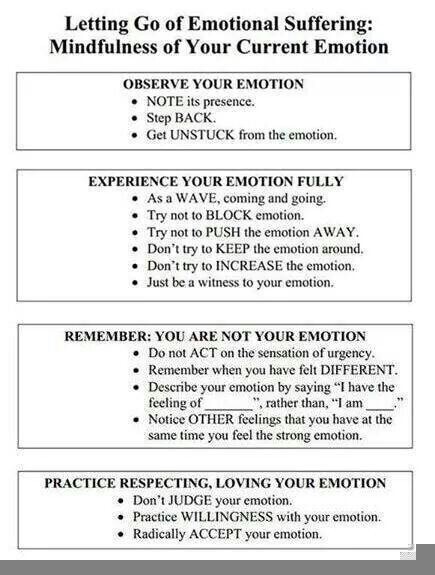
Emotional Regulation | How to Let Go of Emotional Suffering

DBT Self-Help Resources: Letting Go of Emotional Suffering
Emotion regulation refers to a person’s ability to understand and accept his or her emotional experience, to engage in healthy strategies to manage uncomfortable emotions when necessary, and to engage in appropriate behavior (e.g., attend classes, go to work, engage in social relationships) when distressed.

People with good emotion regulation skills are able to control the urges to engage in impulsive behaviors, such as self-harm, reckless behavior, or physical aggression, during emotional distress.


NEW YORK CITY:  Emotion regulation refers to a person’s ability to understand and accept his or her emotional experience, to engage in healthy strategies to manage uncomfortable emotions when necessary, and to engage in appropriate behavior (e.g., attend classes, go to work, engage in social relationships) when distressed.

People with good emotion regulation skills are able to control the urges to engage in impulsive behaviors, such as self-harm, reckless behavior, or physical aggression, during emotional distress.